Support hotline
400-810-0881



Fluorescent Dye Table - A Comprehensive Guide
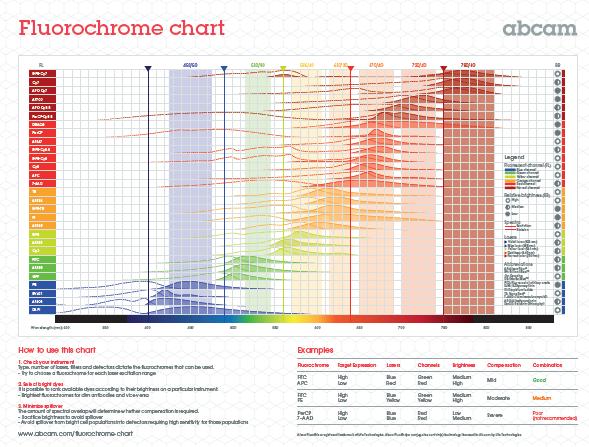
Fluorescent dyes (or fluorescein) are commonly used as detection reagents for a variety of applications, including cell imaging and flow cytometry. Fluorescent dyes absorb light energy at specific wavelengths and then re-emit light energy at longer wavelengths. The wavelengths at which the fluorescent dye absorbs and emits light constitute the excitation and emission spectra (or simply fluorescent dye spectra) of the fluorescent dye, respectively.
Flow cytometry or other instruments that require the use of fluorescent dyes are equipped with a laser that produces light of a particular wavelength to excite fluorescent dyes that absorb light at that particular wavelength. The light emitted by the fluorescent dye then passes through the filter, so each sensor can only detect a range of filtered filtered fluorescence. The detected fluorescence is the signal recognized by the instrument.
Many different fluorescent dyes have been developed, each with a specific emission and excitation spectrum. Fluorescent dyes that can absorb and emit light of a particular wavelength throughout the visible spectral range, including the infrared region, are now commercially available. In addition, the intensity of the light emitted by the fluorescent dye is also different. The brightness of a fluorescent dye depends on its ability to absorb light and the efficiency with which light is converted into emitted light.
Choosing a fluorescent dye suitable for subsequent experiments may be difficult without the aid of a suitable tool. If the designed experiment is a multicolor experiment requiring two or more fluorescent dyes, the choice of fluorescent dye will become more difficult. In multicolor experiments, attention must be paid to spectral overlap between fluorescent dyes and other factors to minimize possible problems, such as fluorescence spills.
Although the tabular form of fluorescent dyes provides information on these factors as comprehensively as possible, the information provided is limited. Therefore, we have drawn a new table of fluorescent dyes to guide you step by step how to choose fluorescent dyes. Our new guide will make the selection process simple and fast.
Zhongyuan Bio is an authorized agent of Abcam
If you have any questions, please call the toll-free service.
400-8100-881
If you have any comments or suggestions on our services, please send them to the following email address.
Service@sinozhongyuan.com
Download Attachment:
 京公網安備11010502040370號
Technical Support:Qingyun Software
京公網安備11010502040370號
Technical Support:Qingyun Software